How do you know where you are?
 For much of human history that wasn’t a particularly easy question to answer, but for many of us today it’s a simple matter of consulting our phones. The same Global Positioning System technology that helps you locate your lost iPhone also makes it possible for you to pinpoint yourself on a map.
And therein lies a minor mystery of the GPS era that University of Virginia astronomy professor Kenneth Seidelmann and a team of co-authors investigated in a paper in the Journal of Geodesy.
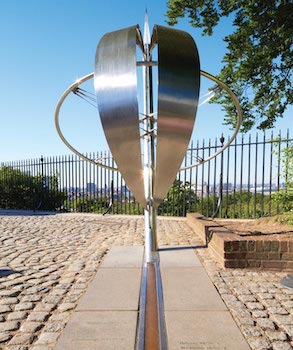
The Royal Observatory in Greenwich, England, is famously home to the line of 0 degrees longitude—the imaginary north-south line that, in the imaginary grid of longitude and latitude that circles the Earth, divides the Eastern and Western hemispheres of the globe. Known as the Greenwich meridian, or prime meridian, the line was established at an international conference in 1884 as the “initial meridian” from which all other lines of longitude would be calculated. Today the Royal Observatory draws hundreds of thousands of visitors each year to straddle the marker that traces the line, one foot in each hemisphere.
There’s only one problem.
“If you go to the Greenwich meridian with a GPS receiver,” Seidelmann says, “it does not measure 0 degrees longitude on the marked Greenwich meridian.”
 carolinekettlewell