Even they can’t always tell themselves apart
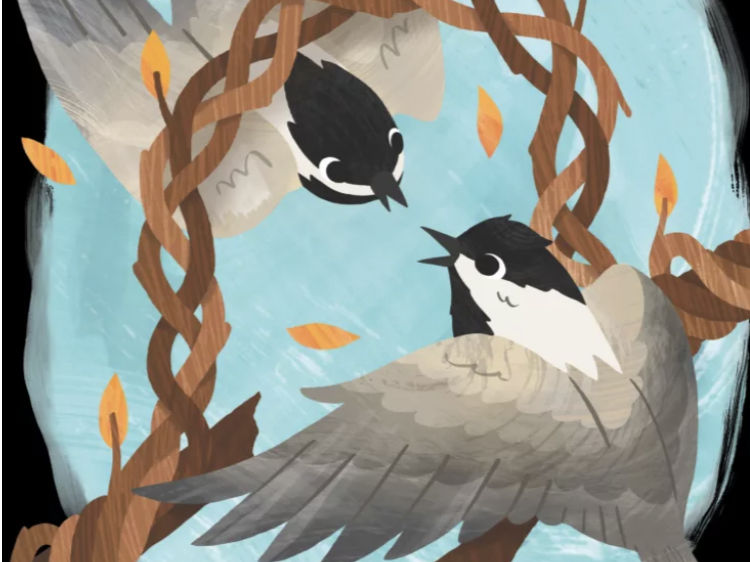 When it comes to birdwatching, to call myself a rank amateur would be an insult to rank amateurs. Give me something incontrovertibly identifiable—your cardinals, your blue jays, your crows and Canada geese—and I’m all swagger and self-confidence. But throw a white-breasted nuthatch or a dark-eyed junco at me, or ask me to make the call between a downy woodpecker and a hairy woodpecker, and, you know, fuhgeddaboudit. I am the proverbial broken reed.
So it was with some satisfaction that I recently learned that even birds occasionally have a hard time with bird I.D. To wit, the Carolina chickadee and the black-capped chickadee. Take a gander at these two birds on the Cornell Lab of Ornithology’s “All About Birds” online bird guide, and tell me you can tell one from the other. No? As it happens, according to the guide, sometimes neither can they. “Where the two species’ ranges come in contact,” the guide advises, “the Carolina and black-capped chickadees occasionally hybridize.”
Part of that range overlap lies in far western Virginia, where, in theory at least, you might see one, you might see the other, or you might see one that’s a little bit of both. Beyond that wedge of Appalachia, though, black-capped chickadees keep themselves mostly to the north and west of Virginia. Carolina chickadees, however, can be found throughout the state. So if you live in, say, Charlottesville or Williamsburg or pretty much anywhere in the state east of Virginia’s narrow western “tail,” you can safely bet that the cute little black-capped chickadee at your feeder is not a black-capped chickadee. Got that clear, now?
Read more about look-alike chickadees in Virginia Living magazine.
 carolinekettlewell